
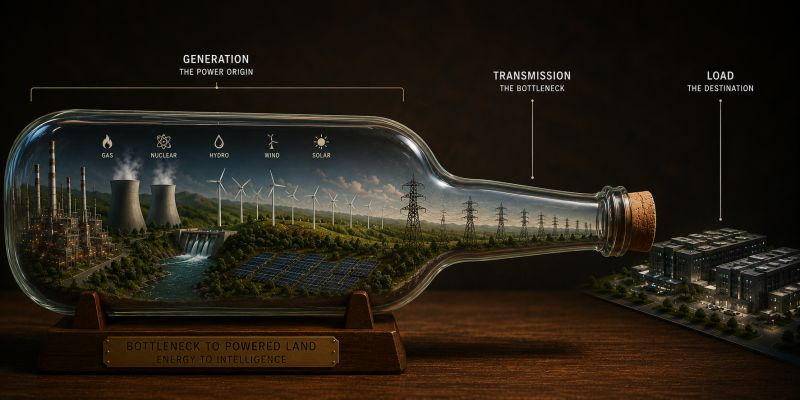
There is a lot of discussion about whether the United States has enough generation to support the next wave of data center demand.
But consider this: more than 2,060 GW of generation and storage was actively seeking U.S. grid interconnection at the end of 2025 — approximately 1,312 GW of generation and 749 GW of storage, according to Lawrence Berkeley National Laboratory's latest Queued Up data.
Of course, much of that capacity will never be built. Berkeley Lab notes that most projects entering interconnection queues are ultimately withdrawn. But the scale illustrates something important:
Generation is only one part of the power problem.
2,060+ GW
Generation + storage actively seeking interconnection
1,312 GW
Generation in the queue
749 GW
Storage in the queue
The bottleneck sits between supply and load
You can have abundant generation in a region and still struggle to serve a new 300 MW, 500 MW, or 1 GW load.
The reason is often transmission. The grid has to move power from where it is generated to where it is consumed. Transmission systems must operate within reliability criteria, contingency requirements, thermal and voltage limits, and the physical capability of individual facilities.
That creates a bottleneck: on one side, more than 2 TW of generation and storage is trying to connect. On the other, rapidly growing large loads are trying to connect. In between sits the transmission system.
The neck of the bottle determines how much power can actually reach the site.
Why the distinction matters for power
For developers, understanding the bottleneck is increasingly the difference between a site that appears to have power and one that actually has a credible path to energization.
A generation-rich market is not necessarily a power-rich location. The relevant question is whether sufficient capacity can be delivered through the transmission system, through the local interconnection, and on the timeline the customer requires.
This is why a credible power strategy cannot stop at generation supply. It has to identify the limiting grid element and understand what must happen for the load to be served.
The transmission challenge is real — and increasingly visible
The U.S. Department of Energy's 2026 draft National Transmission Needs Study concludes that additional transmission infrastructure is urgently needed to support load growth, new generation interconnection, new load interconnection, and congestion relief.
At the same time, DOE reports that the majority of transmission congestion is concentrated in approximately 5% of hours. That does not mean the remaining capability is automatically available for new load. It does mean that the character and timing of a constraint matter.
A line that is persistently overloaded presents a different problem from a facility that becomes limiting only under a narrow set of peak or contingency conditions. Understanding that distinction can change the solution set.
Smarter utilization
The answer lies in using the infrastructure we already have more intelligently.
Depending on the specific constraint, the answer may involve traditional transmission expansion, targeted upgrades, reconductoring, grid-enhancing technologies, storage, onsite resources, phased energization, load flexibility, or some combination of these approaches.
None of those tools eliminate the need to build new transmission. The objective is to understand the actual bottleneck first — and then match the solution to the problem.
Getting more through the bottle
The opportunity is not simply finding more power. It is finding credible ways to deliver more power to load.
For developers, that shifts the work from identifying nominal megawatts to identifying executable megawatts: capacity that can actually reach the site, on a credible timeline, with a clear understanding of the infrastructure and operational conditions required to support it.
The next wave of large-load development will require enormous amounts of new infrastructure. But the projects that move fastest may also be the ones that understand the existing grid well enough to see exactly where the bottle narrows — and what can be done about it.