
Are we measuring "speed to power" correctly?
Speed to power has become the industry's dominant metric. Understandably so. For data-center developers, every year of delay has enormous commercial consequences.
Speed alone does not tell us whether a power solution is viable. Speed at any cost is not a sustainable development strategy.
When plans for enormous, fully islanded power campuses begin to look like the default answer, I do not necessarily see an efficient market. I see a market responding to grid constraints and a mismatch between supply and load with increasingly capital-intensive workarounds.
That does not mean those projects will never be appropriate.
It does mean we should ask whether building an entirely new power plant to island each large load from the grid is always the most efficient answer. That is a huge undertaking to do in a reliable fashion — it means multiple layers of redundancy and ultimately economic inefficiency.
The Supply Story
The United States has an enormous pipeline of potential new supply. Berkeley Lab reports that, at the end of 2025, more than 2,060 GW of generation and storage capacity was actively seeking interconnection to the grid. EIA projected a record 86 GW of new utility-scale generating capacity additions in 2026 alone.
That is not the same as saying 2,060 GW of firm power is available today. Many queued projects will never be built. Others are intermittent, located far from demand, or dependent on transmission upgrades before they can operate.
The harder problem is converting abundant potential supply into power that is interconnected, reliable, economically viable, and deliverable where and when customers need it.
The Grid Story
The grid is not uniformly constrained across every location, season, and hour. DOE's 2026 draft National Transmission Needs Study notes that the majority of observed transmission congestion is concentrated in just 5% of hours.
If constraints vary by location and time, then the answer cannot always be to duplicate the entire power system behind the meter.
A megawatt available quickly may also require:
- Significant upfront infrastructure
- Expensive behind-the-meter generation
- New fuel-delivery capacity
- Long-term operating commitments
- Technology or permitting risk
- Infrastructure that cannot scale economically
Conversely, the lowest-cost solution on paper may take too long to build — or depend on transmission and generation upgrades with uncertain delivery dates.
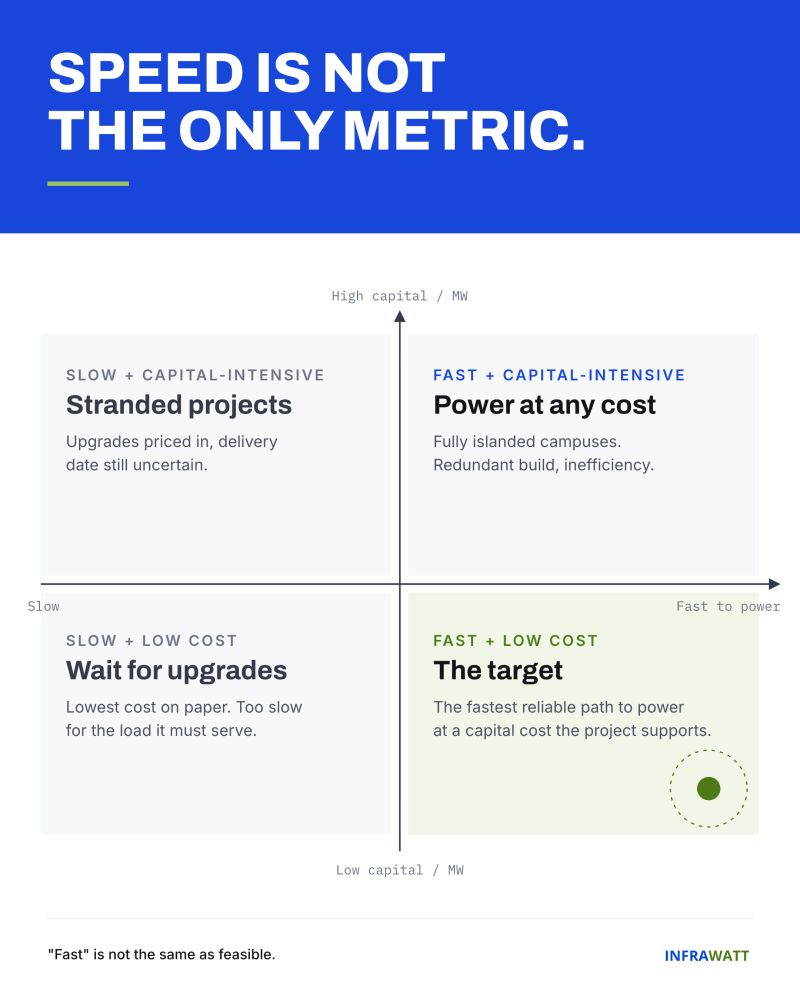
So perhaps the better question is not simply:
"How quickly can power be delivered?"
It is
"What is the fastest reliable path to power at a capital cost the project can support?"
That requires looking beyond an energization date. The relevant measures include:
- Time to initial power
- Capital per delivered megawatt
- Reliability and operating limitations
- Ability to scale
- Exposure to permitting and procurement risk
- Certainty that the proposed power will actually be delivered
The challenge
The United States unquestionably needs more generation and transmission.
However, we should not confuse a failure to connect and deliver available resources with an absolute absence of potential supply.
Not every constraint is identical. Not every project requires the same infrastructure. And not every fast megawatt creates the same value.
The challenge is finding the combination of time, cost, reliability, and certainty that converts abundant resources into genuinely valuable megawatts.
Because "fast" is not the same as feasible.
Over time, the market will move toward an economic equilibrium — one that optimizes speed and cost.